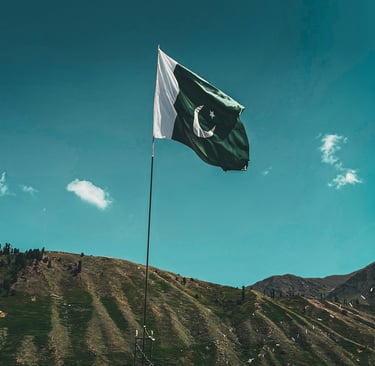
The number has dominated headlines, but the figure itself is only the outcome of a much deeper problem. Pakistan's debt did not emerge because of one government, one financial crisis or one global recession. It is the result of structural weaknesses that have accumulated over decades.
A Debt Trap Built Over Time
Every government borrows. The difference lies in what the borrowed money ultimately creates. Countries that invest borrowed capital into manufacturing, exports, infrastructure and productive industries often generate enough economic growth to service those loans comfortably. Pakistan has struggled to create that cycle.
Instead, successive governments have repeatedly borrowed to finance fiscal deficits, repay earlier loans and manage immediate financial pressures. As old debt matured, new borrowing often became necessary, creating a cycle from which the country has found it increasingly difficult to escape. The weakening of the Pakistani rupee has further increased the domestic cost of servicing foreign debt, while high interest rates have made domestic borrowing significantly more expensive.
Politics and the Economy Cannot Be Separated
Economic reform requires political continuity. Pakistan has rarely enjoyed that luxury. Frequent political confrontations, changes in government and institutional uncertainty have repeatedly delayed long-term economic decision-making. The imprisonment of former Prime Minister Imran Khan has further intensified political polarization at a time when investor confidence is already under pressure. For businesses and international investors, uncertainty often becomes as damaging as economic weakness itself.
Security Carries an Economic Cost
Pakistan's internal security environment also continues to place pressure on public finances. Security operations involving the TTP and the BLA require significant financial resources, while recurring instability in parts of the country affects investment, infrastructure development and commercial activity.
Relations with neighbouring Afghanistan have also witnessed repeated tensions over border security and cross-border violence in recent years, adding another layer of complexity to Pakistan's strategic environment. These challenges do not exist in isolation. Every additional rupee spent managing prolonged security concerns reduces the fiscal space available for development priorities.
Pakistan's central government debt has climbed to a record PKR 81.9 trillion. The figure is not merely an economic statistic, it reflects decades of fiscal mismanagement, political uncertainty, persistent security challenges and an economy that has struggled to generate sustainable growth while remaining dependent on repeated external assistance.
By Abhinav Mudaliar
Chief Analyst, The Centre
29 June 2026 • 1:20 PM IST • 5 min read
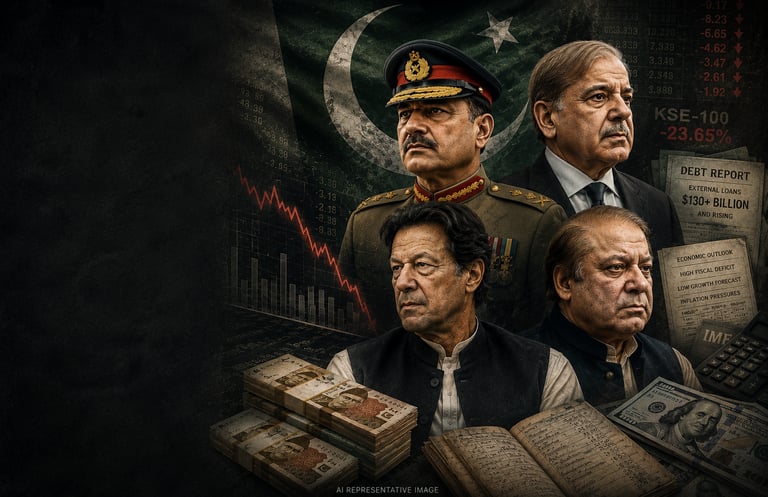
Pakistan has once again reached an economic milestone that few countries would celebrate. According to official figures released by the State Bank of Pakistan, the country's central government debt has risen to approximately PKR 81.9 trillion, the highest level in its history.
The Cost of Strategic Competition
Pakistan's long-standing strategic competition with India has also shaped its fiscal priorities. Maintaining military preparedness against a significantly larger neighbour has required sustained defence expenditure over decades. National security remains a sovereign responsibility for every country, but defence spending inevitably competes with investment in education, healthcare, infrastructure and industrial expansion when government revenues remain constrained.
For a country already facing weak revenue collection and rising debt-servicing obligations, these trade-offs become increasingly difficult.
An Economy Dependent on External Support
Pakistan has repeatedly relied on financial assistance from the International Monetary Fund and other international lenders to stabilize its economy during periods of financial stress.
These programmes have helped prevent deeper crises and supported foreign exchange reserves, but they have not fundamentally resolved the structural issues that continue to generate fiscal deficits. Each programme has come with commitments to improve tax collection, strengthen public finances and implement economic reforms. While progress has been made in some areas, the broader challenge of building a self-sustaining economy remains.
Why the PKR 81 Trillion Figure Matters
The most worrying aspect of Pakistan's debt is not simply its size but the burden it places on future budgets. A substantial share of government revenue is now directed towards servicing existing debt before money can be allocated to education, healthcare, infrastructure or economic development. This leaves governments with fewer policy options and increases dependence on additional borrowing whenever new financial pressures emerge.
The Road Ahead
Pakistan's record debt should be viewed as a warning rather than an isolated statistic. The country's economic future will depend on whether it can expand exports, strengthen manufacturing, widen its tax base, improve investor confidence and create sufficient long-term growth to reduce its dependence on borrowing.
Without meaningful structural reforms and greater political stability, debt is likely to remain one of Pakistan's defining economic challenges. The PKR 81.9 trillion figure therefore represents more than a record. It reflects decades of unresolved structural problems that continue to shape Pakistan's economic trajectory.