President Donald Trump's latest remarks indicate that Washington's patience has diminished sharply. Declaring that he no longer wants to negotiate with Iran's leadership and questioning the value of further diplomacy marks one of the strongest public shifts in tone since the latest crisis began. Whether these remarks represent negotiating pressure or a genuine policy shift remains to be seen. What is clear, however, is that the diplomatic momentum generated by the ceasefire has largely disappeared.
A Ceasefire Without a Settlement
History shows that ceasefires often stop fighting without resolving conflict. The United States and Iran never reached an agreement on the issues that mattered most. Iran continued to defend its strategic posture. The United States continued to insist that Iran's nuclear ambitions and regional activities posed an unacceptable threat. The ceasefire therefore addressed the symptoms of the crisis, not its causes. Without a political settlement, renewed confrontation always remained a possibility.
Trump's Language Signals a Harder Phase
The significance of President Trump's recent comments lies not simply in their tone but in what they may indicate about Washington's strategic thinking. Calling further negotiations pointless and using unusually harsh language to describe Iran's leadership suggests growing scepticism that diplomacy can produce meaningful results. Political rhetoric does not always translate directly into policy. However, when such rhetoric is accompanied by renewed military activity and the apparent collapse of diplomatic engagement, it becomes difficult to dismiss it as merely a negotiating tactic.
When the ceasefire was announced, many viewed it as the beginning of de-escalation. At The Centre, our analysis suggested it was more likely to be a pause than a peace. Recent events now appear to support that assessment, as diplomacy gives way once again to confrontation.
By Abhinav Mudaliar
Chief Analyst, The Centre
10 July 2026 • 4:30 PM IST • 5 min read
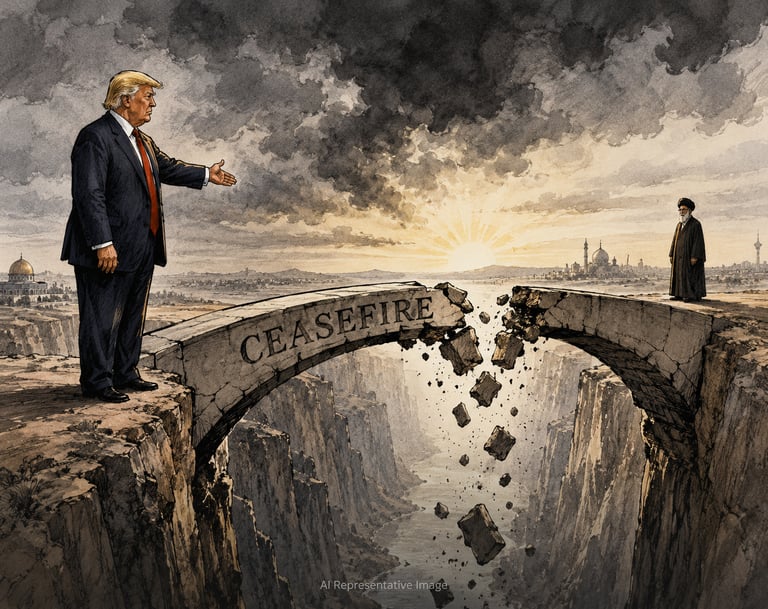
The ceasefire between the United States and Iran was always fragile. While it temporarily reduced military tensions, it did little to address the issues that had brought the two countries to the brink of direct confrontation. The nuclear programme, regional influence, sanctions, proxy networks and decades of mutual distrust remained untouched. That is why, when the ceasefire was first announced, The Centre argued that it should be seen as a tactical pause rather than a strategic breakthrough. Today, that assessment appears increasingly relevant.
The Diplomatic Window Is Narrowing
Diplomatic channels rarely close completely. Even during periods of open hostility, governments often continue communicating indirectly through intermediaries. But diplomacy requires both sides to believe that negotiations remain worthwhile. At present, that belief appears weaker than it was only a few weeks ago. The ceasefire has effectively broken down, and the prospects for meaningful negotiations have diminished significantly.
The Region Watches Carefully
The consequences extend well beyond Washington and Tehran. Israel, the Gulf states, European powers, Russia and China all have significant interests in how this confrontation develops. Energy markets remain sensitive to instability in the Gulf. Any prolonged escalation could have consequences for global trade, shipping routes and regional security. For India, the stakes are equally significant. Energy security, the safety of the Indian diaspora in West Asia and broader regional stability all remain closely tied to developments between the United States and Iran.
Beyond the Headlines
The real story is not that the ceasefire has ended. The real story is that the conditions necessary for a durable peace never truly existed. Temporary pauses can reduce violence. They cannot substitute for political agreements built on mutual trust and compromise. The coming weeks will determine whether the current confrontation remains limited or evolves into a more prolonged strategic conflict. For now, one conclusion appears increasingly difficult to avoid. The ceasefire may have ended, but the deeper contest between Washington and Tehran is entering a new phase rather than approaching its conclusion.