
The United States has announced a landmark civilian nuclear cooperation agreement with Saudi Arabia. On paper, the objective is straightforward: helping the Kingdom diversify its energy mix, reduce dependence on hydrocarbons and build a modern civilian nuclear industry. Yet beneath the technical language lies a geopolitical shift whose consequences could reverberate across the Middle East for decades. This is not merely an energy agreement. It is a strategic signal. The question is no longer whether Saudi Arabia will generate electricity through nuclear reactors. The real question is whether Washington has begun reshaping the region's nuclear architecture.
More Than Electricity
Civilian nuclear programs are, by themselves, legitimate. Countries around the world operate nuclear power plants under international safeguards. But nuclear technology has always carried a dual character. The scientific expertise, industrial capacity, fuel-cycle infrastructure and regulatory ecosystem developed for peaceful purposes can also provide the technological foundation for a future weapons option if a country's strategic environment changes. The political decision to cross that line is entirely separate, but the capability developed today shapes the choices available tomorrow. That distinction is precisely why agreements involving uranium enrichment have historically attracted such intense scrutiny.
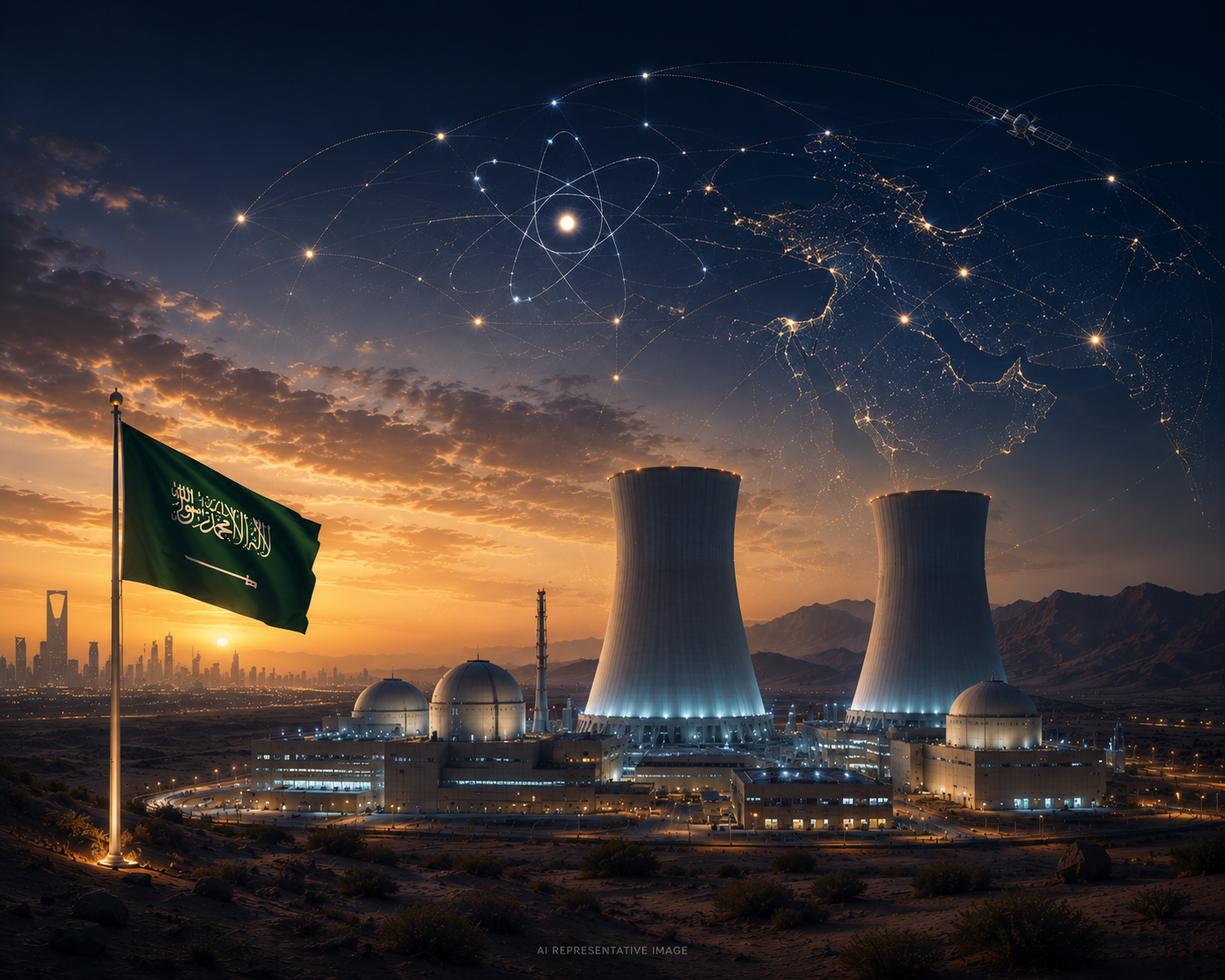
Washington Has Given Saudi Arabia More Than a Civilian Nuclear Program
For decades, one principle quietly underpinned American nuclear diplomacy in the Middle East: civilian nuclear cooperation should not create new pathways toward nuclear weapons. That principle may now be changing.
The agreement is designed for peaceful nuclear energy, but it could also reshape the strategic landscape of the Middle East by expanding Saudi Arabia's long-term nuclear capabilities and altering regional deterrence.
By Abhinav Mudaliar
Chief Analyst, The Centre
24 July 2026 • 12:15 PM IST • 7 min read
The Significance of Uranium Enrichment
The most consequential aspect of the reported agreement is not the construction of reactors. It is Washington's willingness to move toward allowing Saudi Arabia greater control over parts of the nuclear fuel cycle, including domestic uranium enrichment under agreed safeguards.
Enrichment is not synonymous with nuclear weapons. Most enrichment used in civilian reactors remains at low levels suitable for power generation.
Yet enrichment technology occupies a unique place in global security. The same technological base that supports civilian nuclear fuel can, under entirely different political circumstances and outside international commitments, be redirected toward military purposes. That is why this development extends far beyond energy policy.


The Emergence of Nuclear Latency
The world often thinks in binary terms: countries either possess nuclear weapons or they do not. Reality is more nuanced. Between those two categories lies what strategic analysts describe as nuclear latency, the ability to develop a nuclear deterrent relatively quickly because the necessary scientific knowledge, industrial infrastructure and fuel-cycle capabilities already exist.
Japan possesses remarkable nuclear latency without nuclear weapons. South Korea has substantial technological capability without an active weapons program. Iran's nuclear program has long been viewed through this same lens. Saudi Arabia may now be moving closer to that category. The Kingdom is not becoming a nuclear weapons state. But it could gradually become a state with significantly greater nuclear capability than it has possessed before. That difference matters.
Iran Changes Every Calculation
No discussion of Saudi Arabia's nuclear ambitions can be separated from Iran. Iran continues to possess one of the region's largest missile programmes and an advanced nuclear programme that has been at the centre of international negotiations for years. Saudi Arabia cannot assume that today's diplomatic environment will remain permanent. For Riyadh, building civilian nuclear capability may be viewed not simply as an energy investment, but as strategic insurance against an uncertain future.
An Ally, Not a Dependent
Saudi Arabia's security relationship with the United States remains fundamental. Its quiet strategic understanding with Israel has also expanded over recent years, driven largely by shared concerns regarding Iran. Yet Saudi Arabia is unlikely to build its national security entirely around external guarantees. History has repeatedly shown Gulf states that alliances evolve, governments change and regional crises can emerge with little warning.
Possessing advanced indigenous technological capability offers strategic flexibility that external security guarantees alone cannot provide. That does not imply an intention to build nuclear weapons. It reflects the logic of strategic autonomy.
The Abraham Accords and Washington's Larger Strategy
The timing of the agreement is equally revealing. Washington has openly linked progress on civilian nuclear cooperation with broader regional diplomacy, including the possibility of Saudi Arabia joining the Abraham Accords. If successful, such a framework would simultaneously deepen U.S.-Saudi ties, strengthen regional cooperation with Israel and reduce China's strategic influence in the Gulf. Viewed through that lens, the nuclear agreement is not merely an energy partnership. It forms part of a much larger effort to reshape the geopolitical balance of the Middle East.
A New Regional Competition
If Saudi Arabia expands its civilian nuclear capabilities, others will inevitably watch closely. Countries across the Middle East may begin asking similar questions. If Riyadh can pursue advanced nuclear infrastructure under international safeguards, should they seek comparable capabilities?
The next strategic competition may not begin with nuclear weapons. It may begin with civilian nuclear industries, indigenous fuel cycles, scientific expertise and technological self-sufficiency. The race would be for capability rather than warheads. History suggests the distinction can become increasingly important over time.
Beyond the Headlines
The United States has not announced support for a Saudi nuclear weapons programme. Nor has Saudi Arabia declared any intention to pursue one. Those facts remain unchanged. What has changed is something subtler, yet potentially more consequential. Washington appears increasingly willing to accept that one of its closest Middle Eastern partners should possess a far more sophisticated civilian nuclear capability than previously contemplated. Whether that capability remains permanently peaceful or eventually becomes part of a broader regional deterrence equation will depend on future political decisions, not today's agreement. But geopolitics is rarely shaped only by present intentions. It is shaped by the capabilities nations choose to build. And in that respect, this agreement may one day be remembered not simply as an energy deal, but as the moment the Middle East quietly entered a new nuclear era.