This year feels different. The government has already announced several important Bills for the session. But alongside the official legislative agenda, another conversation has quietly taken over political circles. Over the past several weeks, major newspapers, television networks and senior political commentators have repeatedly suggested that the government may be preparing to introduce one of the biggest constitutional reform packages seen in decades.
Nothing has been officially confirmed. Yet the frequency of these reports has become impossible to ignore. At the centre of the speculation lies a simple question. Will Parliament once again debate the Women's Reservation Bill?
If the answer turns out to be yes, the legislation may be far bigger than its title suggests.
The Political Arithmetic Appears Very Different This Time
Constitutional amendments are not ordinary legislation. Governments do not introduce them unless they believe the numbers are within reach. Unlike ordinary Bills, constitutional amendments require a special majority, making political arithmetic far more important than political messaging. This is perhaps why speculation has intensified. Over the last few months, Parliament itself has changed.
The recognition of rebel Trinamool Congress MPs as a separate group has altered the numerical landscape. Developments inside the Shiv Sena (UBT) have added another layer of uncertainty. Political observers are also watching whether sections of the NCP (Sharad Pawar faction) eventually support certain constitutional reforms if broader concerns regarding representation are addressed. Whether these developments actually translate into votes remains unknown. But they have unquestionably changed the calculations that governments make before introducing legislation requiring constitutional majorities.
Women's reservation, a larger Lok Sabha, delimitation, One Nation, One Election and changing political equations have all become part of the conversation ahead of Parliament's Monsoon Session. While much of it remains speculation, the sheer scale of the constitutional questions being discussed suggests this may not be an ordinary legislative session.
By Abhinav Mudaliar
Chief Analyst, The Centre
19 July 2026 • 4:15 PM IST • 7 min read
Every Monsoon Session has its share of political confrontation. Governments introduce Bills. The Opposition raises uncomfortable questions. Television debates become louder than parliamentary debates, and by the end of the session the headlines are usually dominated by disruptions rather than legislation.
A Women's Reservation Bill
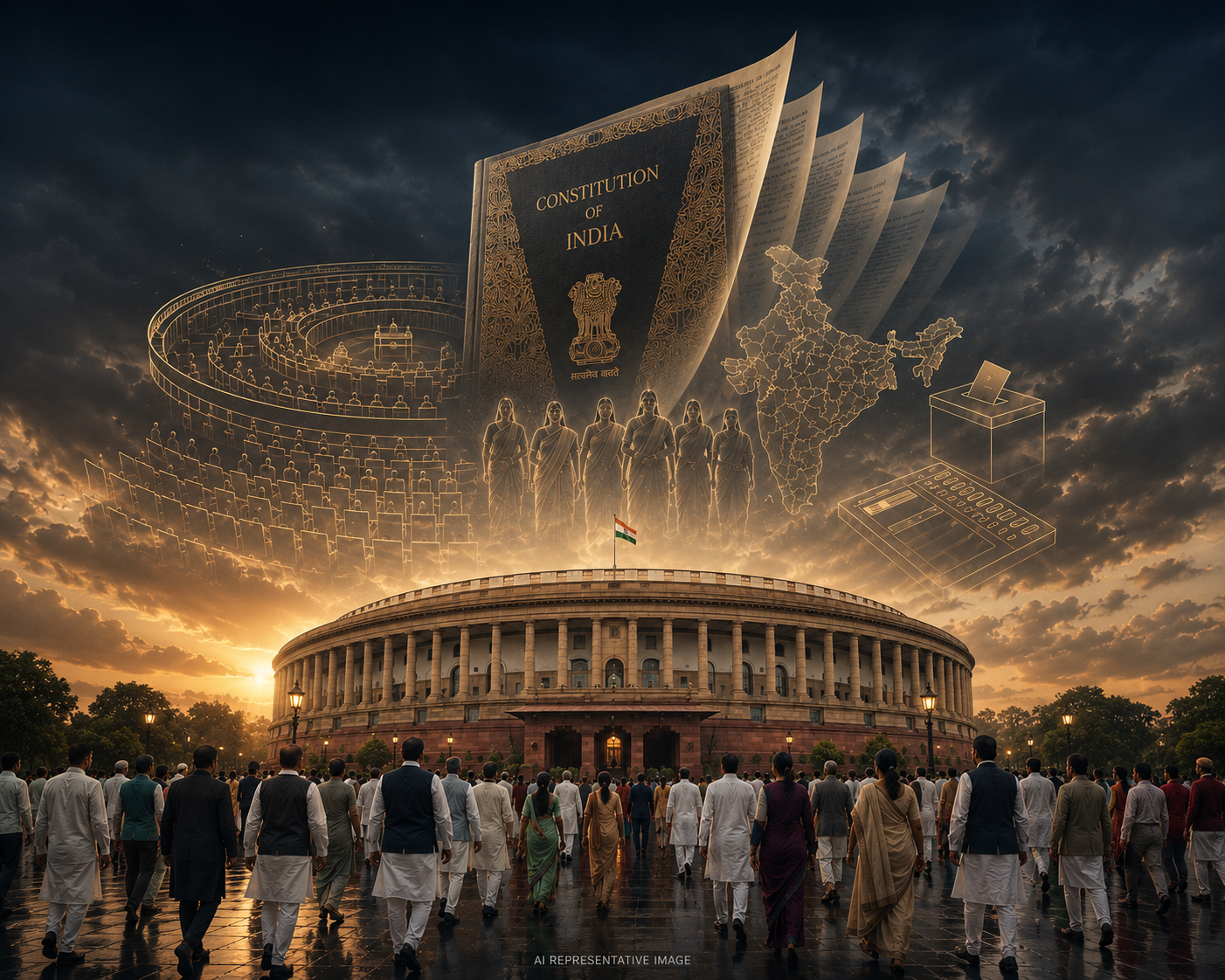
The biggest misconception surrounding the current discussion is that it concerns only women's reservation. Reports emerging from political circles suggest something far more ambitious. Instead of merely implementing one-third reservation for women, the broader package reportedly seeks to combine women's reservation with delimitation and a substantial expansion of the Lok Sabha itself.
If those reports prove accurate, Parliament will not simply be debating representation for women. It will be debating the future structure of India's representative democracy. That changes everything. Instead of discussing a single constitutional amendment, Parliament would effectively be redesigning the architecture of the world's largest democracy for the decades ahead.
Why Increasing the Lok Sabha Changes the Entire Debate
Perhaps the most striking part of the speculation is the reported proposal to expand the Lok Sabha by nearly fifty per cent. Today, the elected strength of the House stands at 543 members.
Political reports suggest that the future House could contain well over 800 elected representatives. That number alone transforms the political debate. Much of the opposition to delimitation has historically come from concerns that some states could lose relative political influence while others gain disproportionately. But if representation across states increases substantially instead of simply being redistributed, the nature of the debate changes. The conversation is no longer only about winners and losers.
It becomes about whether India's Parliament itself has outgrown its current size. For a country that has added hundreds of millions of citizens since the last major delimitation exercise, that is a constitutional question worthy of serious discussion.
Will Regional Parties Rewrite the Political Equation?
Perhaps the most fascinating aspect of this debate is that it refuses to follow traditional alliance politics. The Congress has repeatedly expressed concerns regarding delimitation and its implications for southern states. Yet reports indicate that several regional parties may approach the issue differently. The JD(S) is already part of the NDA. The Telugu Desam Party remains one of the government's most important allies.
Political observers are also closely watching the DMK. Recent political developments have fuelled speculation that if representation across states increases proportionately rather than being redistributed according to the population, the party's final position may differ from that of the Congress. There is also growing discussion around how parties such as the Biju Janata Dal and the YSR Congress Party may eventually position themselves if such legislation is introduced. Whether these assessments ultimately prove correct remains to be seen. But one thing is already evident. This debate is unlikely to divide Parliament neatly into government versus opposition. Instead, it could divide parties according to regional interests, constitutional philosophy and electoral calculations.
The Uttar Pradesh Question
Politics is ultimately about incentives. If reports suggesting a significant expansion of Lok Sabha seats are accurate, states like Uttar Pradesh could see a substantial increase in parliamentary representation. That immediately creates difficult political choices. Would opposition parties representing Uttar Pradesh oppose legislation that significantly increases their state's voice inside Parliament? Or would they align with Congress? These questions have no easy answers. But they demonstrate why this debate is far more complicated than a simple discussion on women's reservation.
The Forgotten Debate: Should the Rajya Sabha Also Expand?
One question has received remarkably little attention. If the Lok Sabha grows by nearly fifty per cent, what happens to the Rajya Sabha? The Upper House exists to represent the states. If one House expands dramatically while the other remains unchanged, the institutional balance between them inevitably shifts. Joint sittings become numerically different. The relative influence of the Rajya Sabha changes.
Perhaps Parliament should debate not only the future size of the Lok Sabha, but whether India's bicameral structure itself needs to evolve alongside it. That conversation has barely begun.
One Nation, One Election Waiting in the Wings
As if one constitutional debate were not enough, another proposal continues to hover over the Monsoon Session. The idea of One Nation, One Election has not disappeared. The Joint Parliamentary Committee continues to examine the proposal, and there are persistent political murmurs that the government may seek to build momentum for another constitutional reform during or after this session.
Whether that happens now or later is secondary. The larger point is unmistakable. India may be entering a period where multiple constitutional questions are debated almost simultaneously. That would make this Parliament unlike any seen in recent decades.
More Than A Session. A Test Of India's Constitutional Future.
For years, Parliament has often been judged by disruptions, walkouts and political slogans. Perhaps this Monsoon Session deserves to be judged differently. If even half the reported constitutional proposals reach the floor of the House, Members of Parliament will not merely be voting on legislation. They will be deciding how India is represented, how its democracy evolves and how future generations elect their governments. That is why the real story may not be whether the Women's Reservation Bill is introduced.
The real story is whether India is about to witness the biggest redesign of its parliamentary democracy since the Constitution first came into force. And if that is indeed the government's ambition, this Monsoon Session may be remembered not for the noise it generates, but for the constitutional legacy it leaves behind.